

Upcoming Events.
greenCHEM x Paludi Challenge
Paludi Challenge
Unlocking the Potential of Paludiculture Biomass
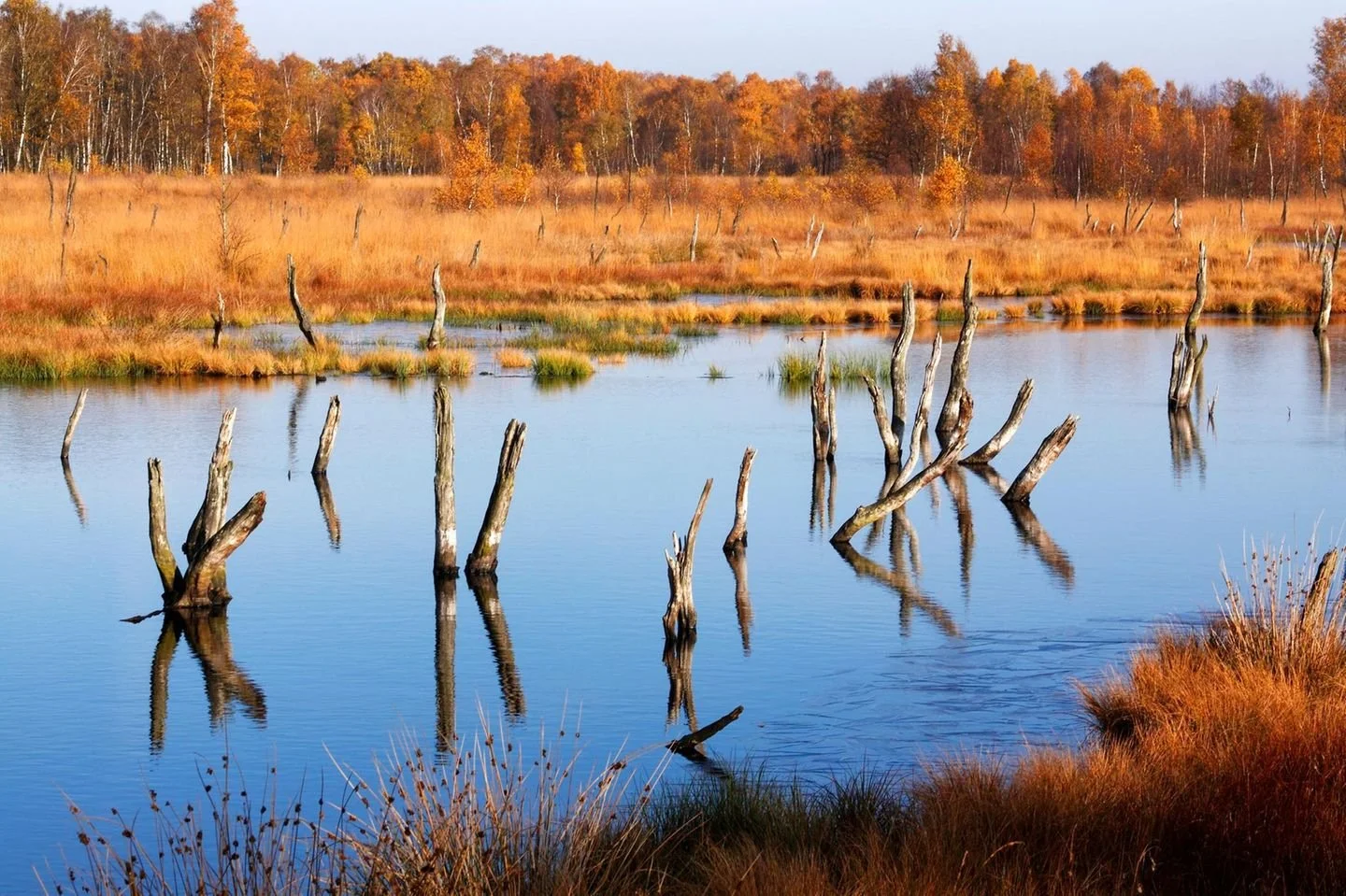
© Justus de Cuveland / imageBROKER / mauritius images
Turn underutilized biomass into real-world applications.
Are you ready to turn sustainability challenges into real-world impact?
Join our Innovation Challenge to develop solutions that unlock the value of paludiculture feedstocks.
We are looking for innovative, application-oriented solutions. Your mission is to develop and validate pathways to convert paludiculture biomass and side streams into market-ready materials, chemicals, or processes. We invite researchers, students, and early-stage teams to participate. We aim to bring creative minds together to address a critical sustainability challenge.
Our Partners
The Greifswald Mire Centre (GMC) is an interdisciplinary hub connecting science, policy, and practice in peatland research. It promotes paludiculture as an innovative solution to reduce CO₂ emissions while enabling sustainable land use. The University of Greifswald is one of the leading research institutions in peatland science, including paludiculture. It develops science-based approaches for restoration and sustainable use of rewetted peatlands, integrating ecological insights with economic and policy-oriented solutions.
The Startup Labor Schwedt is an innovation hub connecting startups, industry, and research to scale sustainable industrial solutions. It supports the development and real-world application of climate-friendly technologies, driving the transition to a circular and climate-neutral industry.
This is where you come in.
-
But what exactly is paludiculture—and why does it matter?
Paludiculture means using wet or rewetted peatlands for farming or forestry. This way, the peatland stays healthy and can continue to store CO₂, which is good for the climate.
It also creates new opportunities to make climate-friendly land use economically viable.
What is the problem right now?
Biomass from paludiculture currently has difficulty competing with other raw materials.
The main challenges are:
• There are only a few ways to process it on a large scale
• There is strong competition from existing materials
• The quality of the biomass is not always consistent
• There is low market demand and uncertain investmentWhat is the Paludi Challenge?
The Paludi Challenge is an initiative that looks for new ideas and solutions.
The goal is to make paludiculture biomass economically useful.
A key focus is to develop processes that turn biomass and/or its byproducts into sellable products, such as chemicals, materials, or industrial processes.
What kind of ideas are we looking for?
The challenge is open and flexible – there is no single fixed solution.
Possible ideas include:
• Development of materials, additives, or packaging
• Use of byproducts (e.g. lignin or hemicellulose)
• New processes or pre-treatment methods to improve usage
• Solutions for technical problems in processing
Wildcards are welcome. You do not need to have a solution already. An idea is enough to apply. You will receive guidance on how to tranform your idea further during the program.
What we offer
Training: Receive hands-on training in key areas such as Life Cycle Assessment, business modelling, and pitching.
Industry Collaboration: Join us on a tour of a real chemical facility, go behind the scenes, and connect with industry experts. Gain practical insights and develop solutions with real-world impact.
Rapid Idea Validation: Use the Challenge to understand and validate the potential of your ideas in a short cycle.
Infrastructure & Equipment: Develop, test, and prototype your ideas in laboratories and lab devices made available by greenCHEM.
Community: Expand your network and get in contact with a diverse ecosystem.
Further Support: Receive potential access to funding opportunities or validation/pilot projects.
Timeline
iStock by Getty Images
Phase 0 – Qualification
April 30— Challenge launch & start of the application phase
• May 30 — Application deadline
• First week of June — Selection and announcement of finalists
Phase 1 – Elaboration
• June 8 — Kick-off event, introduction to the challenge & matchmaking session
• June 18 — Workshop: Life Cycle Assessment (LCA)
• June 23 — Workshop: Business Model Canvas (BMC)
• July 6 — Industry excursion*
• July 13 — Mentoring Session I
• July 20 — Pitching workshop
• July 30, 2026 — Phase 1 Pitch Day & selection of the two winning teams
Phase 2 – Lab Phase
• Beginning of August — Start of the lab phase*
• End of August — Mentoring Session II*
• End of September — End of the lab phase & Final Pitch Day*
* Dates to be confirmed.
Application Deadline: 30th of May, 2026
〰️
Application Deadline: 30th of May, 2026 〰️
Our Workshop Trainers
We are excited to collaborate with an interdisciplinary group of workshop trainers supporting participants throughout the challenge.
Janna Kuhlmann
Workshop Lead in Life Cycle Analysis
Janna is enabling start-ups since over five years to develop and improve their ideas early in the process, based on life cycle assessment (LCA) data.
She has worked for consultancies in the field of cradle to cradle certification and regulatory chemistry. Since recently, she is assisting greenchem start-ups with their first steps in the EU chemicals regulation REACH.
Her background is in environmental chemistry and ecotoxicology, eager to work towards a non-toxic circular economy.

Elif Nisa Ersoy
Workshop Lead in Business Model Canvas
Nisa is a manufacturing and scale-up engineer with experience in bringing technologies from pilot to production.
She has worked in industrial environments including Tesla and global manufacturing companies, focusing on process development, production ramp-up, and operational scaling.
Today, she supports early-stage and research-based teams in translating technical ideas into realistic, scalable business models with a focus on feasibility, execution, and real-world constraints.
Jelle De Wit
Workshop Lead in Pitching & Communication
Jelle is a Berlin-based pitch and public speaking coach from Belgium.
He supports researchers in communicating their ideas with clarity, confidence, and impact—whether in presentations, pitches, or interdisciplinary settings.
His approach combines strong content with storytelling, body awareness, voice, and presence, drawing on his background in devised theatre and performance.
Q&A
-
You want to put your ideas to the test and contribute to making the industry more sustainable
You want to expand your network and meet people from industry
You want to do something that matters with your green chemistry skills
-
This challenge is designed for:
PhD students & postdocs
Master students
Early-stage teams (not incorporated)
Individuals or interdisciplinary teams
We aim to include people from all backgrounds to ensure an interdisciplinary challenge. You do not need any specific qualifications to participate.
Eligibility: Applicants must be based in or near Berlin and able to attend the program in person on the scheduled dates. Additionally, applicants must be affiliated with one of the partner universities within the BUA.
We can only provide lab access to individuals with prior laboratory experience. If you or your team do not meet this requirement, we will support you from the beginning by connecting you with interdisciplinary team members who have the necessary experience to enable lab work.
If you are alone and you do not have a team yet, do not worry! You can still aplly and we will match you with participants from interdisciplinary backgrounds on the first day of the challenge. -
To be considered, applicants must complete and submit the application form, including information about their background and a clear description of their idea, solution, or insights. Participants are also encouraged to support their submission with additional materials such as detailed concepts, videos, explanations, or references to relevant resources like peer-reviewed articles or patents. Submissions will be evaluated based on five key dimensions: market potential, technical feasibility, sustainability, innovation, and industrial relevance.
The program unfolds in two interconnected phases that guide teams from idea development to hands-on validation.In Phase 1 — Elaboration, an open call leads to the selection of 5–7 teams, who then focus on developing and refining their ideas. Throughout this phase, participants receive mentoring, take part in workshops, and gain support in validating their concepts. The phase culminates in a pitch to a jury, where the top two teams are selected to move forward into Phase 2.
Building on the outcomes of Phase 1, Phase 2 — Lab Work offers a more practical, experimentation-driven environment. The selected teams enter the lab to test and technically validate their approaches, continuously iterating with support from experts. The program concludes with a final pitch and award, showcasing the most promising solutions.
Please note: We typically recommend to form teams with not more than four team members in the beginning. In addition, we strongly advise including a scientific supervisor or professor who can provide guidance throughout the entire challenge.
All sessions in the first phase of the program will take place in person; online participation will not be available. -
You can find the Terms and Conditions here.
-
All information about the IP conditions, you can find here.
-
greenCHEM will provide access to lab space and cover the costs associated with that for teams that require it. However, if your team doesn’t need a dedicated lab from greenCHEM, you may work in your current lab. In that case, we can cover some of the costs associated with participating in the challenge, even if we’re not the ones providing the lab.
-
At the application stage, you do not need a fully developed solution.
We are looking for:
A clear idea or concept
A strong hypothesis or approach
A convincing explanation of its potential
Selected teams will further develop their solution during the program. Should your team be selected for the second phase of the challenge, you will have the opportunity to work in the lab and further develop your solution.
And wildcard solutions are always welcome.
-
Teams may focus on one (or combine) the following paths:
Path A — Product-first / Market pull
Investigate materials, additives, binders, coatings, composites, and packaging-related solutions based on paludi inputs that could enable future market applications.
Path B — Side-stream conversion ( “leftover streams” )
Secondary material streams can be repurposed for other products or processes. Develop approaches to upgrade side streams (e.g., hemicellulose- and lignin) into valuable chemical intermediates, materials, or precursors.Path C — Solve a bottleneck ( Fixing a technical process limitation)
Develop a concept for pre-treatment/ fractionation/ separation steps that enable better yields, purity or robustness for paludi utilization.
More Questions?
Join our Info Session on 19.05.26 at 2 PM. Ask your questions, gain deeper insights into the challenge, and get to know the team behind it.

If you can not make it to the Info session, Arni, our Open Innovation Manager, is happy to answer your questions.

Industry Connect

Industry Connect
Good chemistry starts with the right people.
Connect with researchers, startups and industry working on the next generation of energy materials and the digital transformation of the chemical industry.
Discover promising technologies. Bring your challenges. Find your next collaboration.
Your next collaboration could start here.
A research breakthrough looking for an application. An industrial challenge looking for expertise. A technology ready for its next step.
Industry Connect brings these starting points into the same room.
Through technology presentations, short pitches and open discussion, we explore where research meets industrial needs—and what it takes to move forward together.
Two topics, plenty to connect over:

Energy Materials
Explore materials, applications and cooperation opportunities for energy technologies

Digitalization of the chemical industry
Discuss how digital approaches can support chemical research, development and production
Ideas on stage. Conversations that take them further.
An opening perspective
A keynote to set the scene for the day’s exchange.
Two thematic blocks
Each combines two presentations, five fast-paced spotlight pitches and a panel discussion connecting research perspectives with industry experience.
Space to connect
Follow up on a pitch, ask a speaker your question and explore shared interests with potential partners.

Ten pitches. Could one be yours?
Working on energy materials or digitalisation in chemistry?
Put your research, technology or industrial challenge in the spotlight. Show the audience what you are working on, why it matters and who you would like to connect with.
Your next collaboration could start here.
Bring your expertise, your questions and the challenge you want to solve.
Partners:


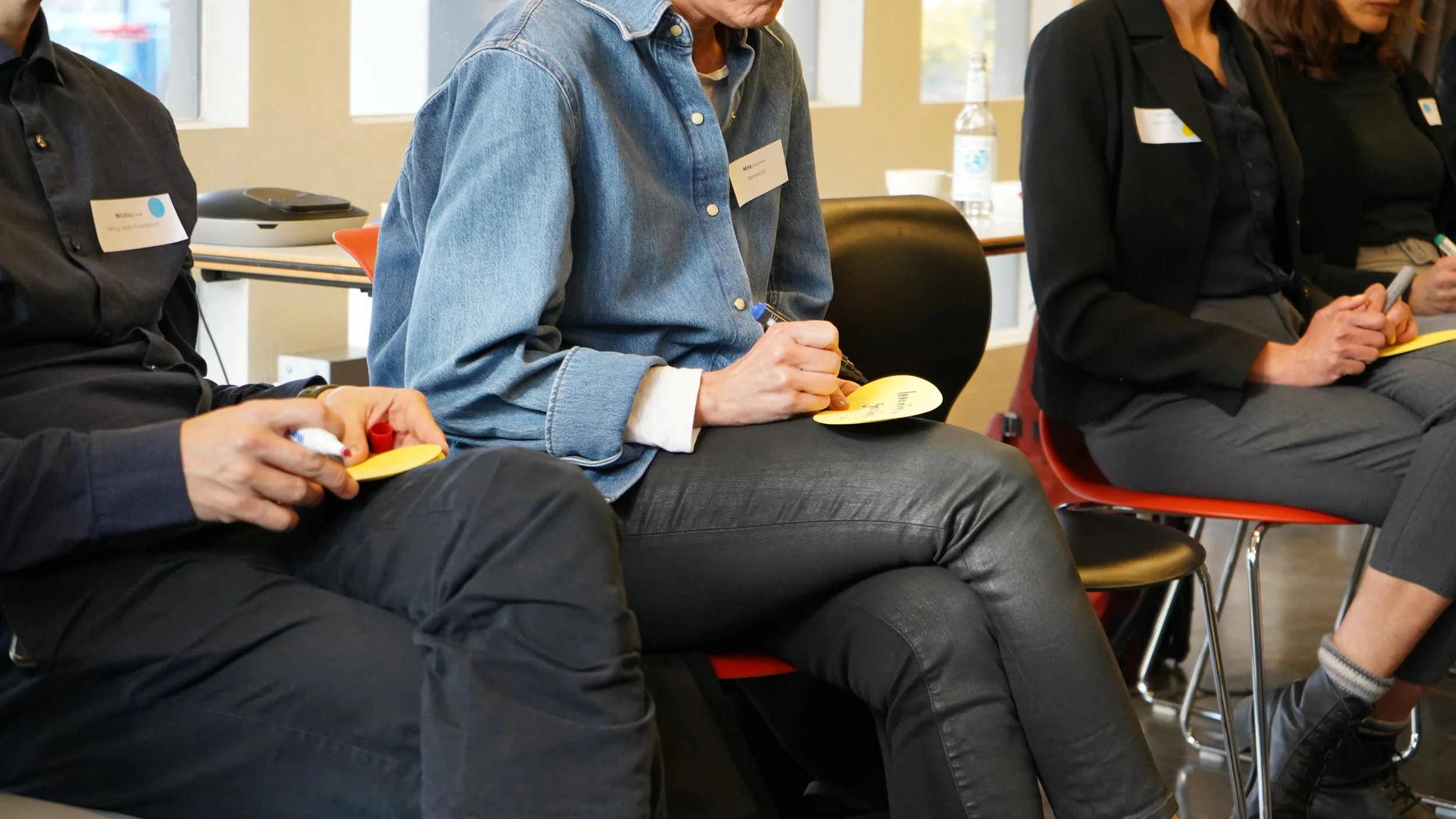
Impressions from previous years:


From Insight to Impact: Framing Challenges for Sustainable Innovation (Part I & II)

From Insight to Impact
Framing Challenges for Sustainable Innovation
Turn sustainability priorities into collaboration-ready innovation challenges
A free two-part executive workshop for Teamleads, R&D, Sustainability and Innovation professionals in chemistry and related industries. In two compact 3-hour sessions, participants translate a real challenge from their company into a structured brief for internal action, Industry Pull, or external collaboration.
Part I: 3 September 2026, 10:00–13:00
Part II: 10 September 2026, 10:00–13:00
Language: English throughout the course. Your registration covers both workshop sessions. Registration is completed via the TU Berlin event portal.
For Teamleads
Bring a structured challenge brief back to your team — including problem framing, scope, success criteria and next-step options.
For Sustainability & ESG
Translate regulatory, circularity and sustainability priorities into concrete innovation topics that can be aligned internally and pursued systematically.
For Innovation & External Collaboration
Decide more clearly whether the next step is internal development, an Industry Pull challenge, startup collaboration, or a university/TTO pathway.
From internal problems to external solutions — frame the right challenges and collaborate effectively.
A hands-on, practice-oriented workshop for industry professionals who want to move from understanding sustainability and green chemistry to clearly framing actionable innovation challenges.
Across the chemical and downstream industries, sustainability goals and green chemistry insights are becoming increasingly concrete and relevant. Many organisations are therefore at a point where the next step is not more knowledge, but clearer structure: how to translate existing insights, ambitions, and ongoing initiatives into focused innovation challenges that can be pursued internally or together with external partners.
Led by an institutional strategy expert and entrepreneurship educator, the workshop combines short methodological and science-based inputs with hands-on group work and peer feedback. By the end of the day, each participant leaves with a concrete, well-framed challenge that can be taken forward within their organisation or explored further through collaboration.
The course also provides insight into how well-framed challenges can be further developed within the greenCHEM ecosystem, while keeping the main focus firmly on participants’ own takeaways and next steps.
Key Benefits
- Turn sustainability goals and green chemistry insights into concrete, actionable innovation challenges.
- Learn structured methods to analyse and frame complex technical, regulatory, market, or ESG-driven problems.
- Work in an interactive workshop format with immediate application, discussion, and feedback.
- Build a shared language between technical and non-technical roles for more effective collaboration.
- Reduce uncertainty in innovation initiatives by clarifying scope, expectations, and feasibility early on.
- Leave with a tangible result: a well-defined or semi-defined challenge relevant to your own role and organisation.

Meet the instructor: Dr. Catharina Werner
University Lecturer and Coordinator of the Digital Entrepreneurship Hub| Freie Universität Berlin
Dr. Catharina Werner teaches entrepreneurship across disciplines, with a focus on entrepreneurial thinking, business model design and practical innovation methods for complex organisational contexts. She played a key role in establishing entrepreneurship education at Freie Universität Berlin, developed several digital learning formats and currently coordinates the Digital Entrepreneurship Hub. Her research focuses on the strategic development and institutional conditions of entrepreneurship education.
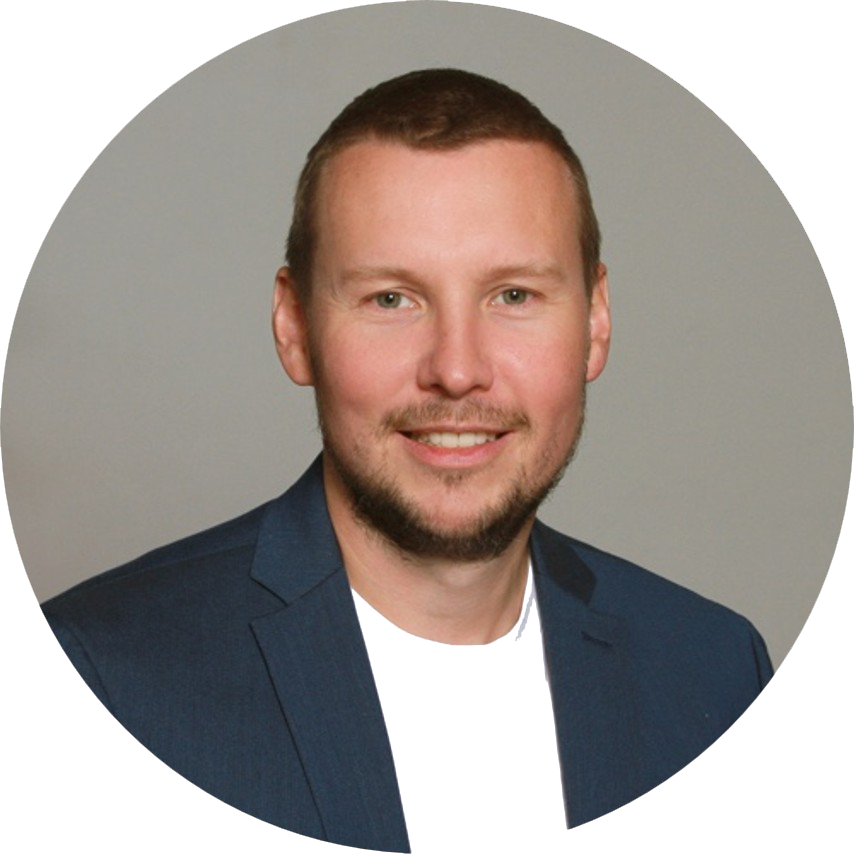
Meet the speaker: Dr. Olaf Wagner
Research and Development of Technologies for Water Purification | Freie Universität Berlin
Dr. Olaf Wagner leads a junior research group at Freie Universität Berlin focusing on the research and development of sustainable materials for water purification. His work spans the path from material design and testing to scale-up and demonstrator development, including projects such as AquaPur, EcoSorb and BioGran. With several years of industry experience and as co-founder of the start-up EverBlue Technologies, he combines academic research with hands-on experience in technology transfer, intellectual property, funding and commercialization.
Program
September 3, 2026: Part 1
10:00–10:15 | Welcome & Course Framing
10:15–10:30 | Problem Types in Green Chemistry Innovation
10:30–11:15 | Interactive Workshop I: Problem Analysis
Interactive introduction to structured methods and simple criteria for identifying, analysing, and framing real-world problems as innovation challenges (technical, regulatory, market, ESG, organisational).
Short inputs and illustrative examples showing how technical and non-technical perspectives approach challenge framing (using internal best practices or adapted/simulated examples where needed).
Immediate application of frameworks to real or realistic cases (i.e from participants’ organisational contexts).
11:15–11:30 | Institutional Logics Perspective
11:30–11:45 | Biobreak with snacks, coffee, water
11:45–12:45 | Interactive Workshop II: Challenge Framing
Guided group work and peer feedback: refine challenge articulation, deepening problem analysis, clarifying assumptions, identifying drivers, constraints and objectives.
Translating analysed problems into structured challenge statements.
This session is explicitly designed as a hands-on workshop, not a lecture.
12:45–13:00 | Wrap up & Preparation for Day 2
September 10, 2026: Part 2
10:00–10:15 | Arrival & Recap of Day 1
10:15–11:15 | Interactive Workshop II: Ideation & Challenge Statement Refinement
Statement Refinement.
Exploring the challenge through a value perspective.
Prototyping possible solution approaches: defining scope, success criteria, boundaries and collaboration needs.
11:15–11:30 | Biobreak with snacks, coffee, water
11:30–12:00 | Mapping Collaboration & Risk
Exploring options for internal and external collaboration.
Practical discussion of feasibility, risk, and evaluation criteria.
Refining the challenge statement through iteration and peer feedback.
Short introduction to greenCHEM and its challenge-based formats as one possible pathway.
12:00–12:10 | Short introduction to greenCHEM and its challenge based formats
12:10–12:35 | Presentation of Challenge Statement
12:35–13:00 | Reflection & Takeaways
Reflection on learnings and individual next steps.
Feedback round and course wrap up.
Who should register?
This workshop is designed for cross-functional industry professionals who want to move from understanding sustainability and green chemistry to actively shaping innovation topics.
Ideal for:
R&D and technical managers
Sustainability & ESG professionals
Innovation and transformation leads
Product and process owners
Procurement and supplier innovation roles
Participants of Course A or B who want to move from understanding to action
Participants typically come from following sectors: manufacturing, chemistry, automotive, packaging, electronics, FMCG, and related sectors. Other sectors are also welcome.
Technology Forecasting

Driven by technology, insipired by sustainability
Lecture & Workshops & Mentoring
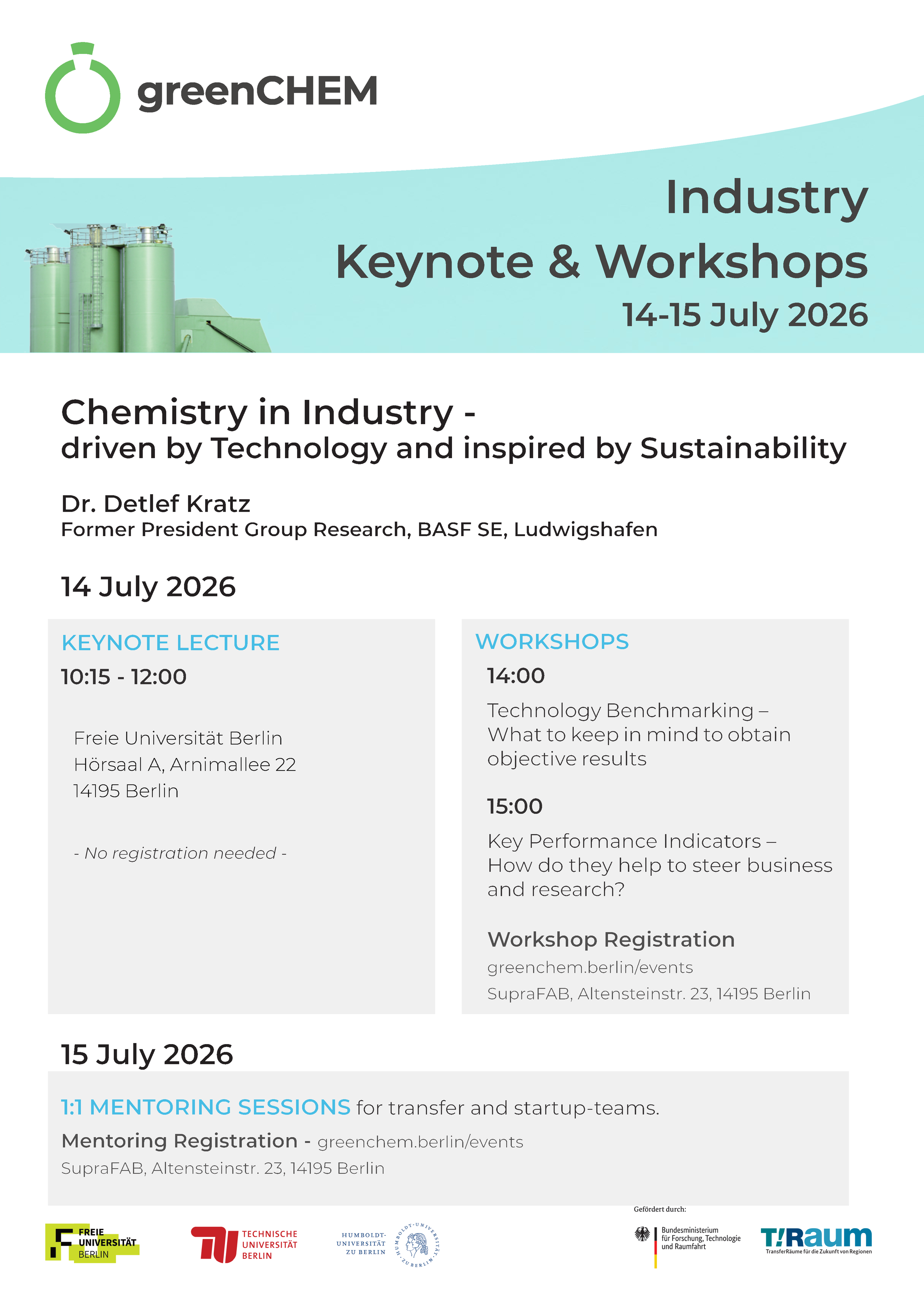
Join us for this two day workshop where Dr. Detlef Kratz, former President Group Research BASF SE shares his insights about Technology Forecasting in the chemical industry, and Key Performance Indicator (KPI) setting for steering your business and research.
This is a two day event with optional coaching sessions on Day 2.
Lecture: Chemistry in Industry - driven by Technology and inspired by Sustainability
Tuesday, 14.07.2026, 10:15 am - 12:00 pm
Freie Universität Berlin, Hörsaal A, Arnimallee 22, 14195 Berlin
Workshop 1: Technology Benchmarking – What to keep in mind to obtain objective results
Tuesday, 14.07.2026, 2 pm
Freie Universität Berlin, SupraFAB, Altensteinstr. 23a, Raum 119, 14195 Berlin
Workshop 2: Key Performance Indicators – How do they help to steer business and research?
Tuesday, 14.07.2026, 3 pm
Freie Universität Berlin, SupraFAB, Altensteinstr. 23a, Raum 119, 14195 Berlin
1:1 MENTORING SESSIONS for transfer and startup-teams (30 mins sessions)
Wednesday, 15.07.2026, 10 am - 4 pm
Freie Universität Berlin, SupraFAB, Altensteinstr. 23a, Raum 101, 14195 Berlin
Enabling Better Choices: Green Chemistry for Professionals - Part 2
Enabling Better Choices
Green Chemistry for Professionals
greenCHEM Further Education · Green Chemistry for Professionals
For professionals across sustainability, procurement, risk, and operations who want a clear, accessible introduction to green chemistry.
From core concepts to real-world cases — understand what matters and how to act on it.
A compact, practice-oriented course for industry professionals who make decisions involving materials, sustainability, procurement, risk, or innovation — without needing a chemistry background. This is the second part of the course:
Getting familiar with the principles of green chemistry and practice oriented session to understand its relevance in realworld cases (June 1, 10-12 am, online)
Getting into specific principles of green chemistry and deeper insights into realword cases and related processes (June 8, 10-12 am, online)
Across industries, green chemistry increasingly shapes regulation, procurement criteria, product development, customer expectations, and risk management. Yet many professionals outside of R&D or technical teams are rarely offered accessible training that explains the fundamentals behind these trends.
This compact online course gives non-chemists in industry a clear, non-technical introduction to green chemistry and its relevance for daily decision-making. Whether you work in operations, procurement, sustainability, product management, compliance, innovation, or engineering, this course helps you recognise where green chemistry affects your business — and how greener decisions can reduce risks and costs while supporting competitive advantage.
Through short expert input, industry-relevant cases, and interactive group exercises, participants build the vocabulary and confidence to assess greener options, ask better questions, and connect chemical concepts to real-world challenges. Each participant leaves with 1–2 concrete follow-up ideas or questions tailored to their own role and organisational context.
Key Benefits
- Understand essential green chemistry concepts in clear, non-technical language.
- Learn structured methods to analyse and frame complex technical, regulatory, market, or ESG-driven problems.
- Connect green chemistry to business performance in industrial settings.
- Ask sharper, more informed questions about materials, hazards, alternatives, or supplier claims.
- Collaborate more effectively with technical teams, R&D, suppliers, and sustainability functions.
- Identify where greener decisions could reduce risk or create value in your products, processes, or policies.
- Upskill quickly: a 2–3 hour online format designed for busy schedules across all industry sectors.
- Leave with actionable takeaways directly applicable to your organisation.
Program
10:00-10:15: Welcome & Reflection of the first session
10:15-10:45: Expert-Led Insight into real-world cases
A non-technical introduction to specific green chemistry concepts.
Industry examples: substances of concern, safer alternatives, circular materials, cleaner processes.
Simple visuals and structured explanations to build confidence and shared understanding.
10:45-11:30: Interactive Business & Case Exercises
Using short real-world cases from industry and startups.
Identify high-impact opportunities for greener materials or processes.
Compare conventional vs. greener alternatives using simple business-relevant criteria.
Role-play internal decision-making (procurement, sustainability, R&D, management). These exercises help participants ask the right questions and evaluate greener options realistically.
11:30-11:45: Discussion on excercises, Q&A
11:45-12:00: Reflection & Action Session
A structured discussion where participants reflect on insights and identify 1–2 concrete actions relevant to their company, products, or processes. Expert feedback reinforces transfer into daily practice.
Who should register?
This course is designed for industry professionals of all seniority levels who influence decisions related to sustainability, procurement, safety, risk, product development, or operations — with no chemistry background required.
Ideal for:
Sustainability & ESG roles, Procurement & supply chain professionals, Product managers & product development teams, Operations, engineering, and quality management, Regulatory affairs & compliance, Innovation managers and project leads
New employees needing a foundational introduction to green chemistry
Industrial firms without in-house R&D, looking to understand greener options more confidently
Participants come from industries such as manufacturing, automotive, electronics, FMCG, textiles, packaging, logistics, machinery, and beyond.
This course can be taken as a stand-alone offering; however, for the best learning outcomes, we recommend also attending the basic course that takes part before and buids the fundamental knowledge of green chemistry. More information can be found here. (June 1, 10-12 am).
Questions?
Contact our Futher Education Manager Irina
See also the information on our Further Education Program!

Enabling Better Choices: Green Chemistry for Professionals - Part 1
Enabling Better Choices
Green Chemistry for Professionals
greenCHEM Further Education · Green Chemistry for Professionals
For professionals across sustainability, procurement, risk, and operations who want a clear, accessible introduction to green chemistry.
From core concepts to real-world cases — understand what matters and how to act on it.
A compact, practice-oriented course for industry professionals who make decisions involving materials, sustainability, procurement, risk, or innovation — without needing a chemistry background. The course takes part in 2 sessions:
Getting familiar with the principles of green chemistry and practice oriented session to understand its relevance in realworld cases (June 1, 10-12 am, online)
Getting into specific principles of green chemistry and deeper insights into realword cases and related processes (June 8, 10-12 am, online)
Across industries, green chemistry increasingly shapes regulation, procurement criteria, product development, customer expectations, and risk management. Yet many professionals outside of R&D or technical teams are rarely offered accessible training that explains the fundamentals behind these trends.
This compact online course gives non-chemists in industry a clear, non-technical introduction to green chemistry and its relevance for daily decision-making. Whether you work in operations, procurement, sustainability, product management, compliance, innovation, or engineering, this course helps you recognise where green chemistry affects your business — and how greener decisions can reduce risks and costs while supporting competitive advantage.
Through short expert input, industry-relevant cases, and interactive group exercises, participants build the vocabulary and confidence to assess greener options, ask better questions, and connect chemical concepts to real-world challenges. Each participant leaves with 1–2 concrete follow-up ideas or questions tailored to their own role and organisational context.
Key Benefits
- Understand essential green chemistry concepts in clear, non-technical language.
- Learn structured methods to analyse and frame complex technical, regulatory, market, or ESG-driven problems.
- Connect green chemistry to business performance in industrial settings.
- Ask sharper, more informed questions about materials, hazards, alternatives, or supplier claims.
- Collaborate more effectively with technical teams, R&D, suppliers, and sustainability functions.
- Identify where greener decisions could reduce risk or create value in your products, processes, or policies.
- Upskill quickly: a 2–3 hour online format designed for busy schedules across all industry sectors.
- Leave with actionable takeaways directly applicable to your organisation.
Program
10:00-11:20: Expert-Led Foundations Session
A non-technical introduction to green chemistry and essential chemical concepts.
How chemistry links to regulation, product safety, supply-chain risk, and competitiveness.
Simple visuals and structured explanations to build confidence and shared understanding.
11:20-11:50: Interactive Perspective Exchange
Share and discuss perspectives about real-world cases and challenges in green chemistry.
Identify high-impact opportunities for greener materials or processes.
Compare conventional vs. greener alternatives using simple business-relevant criteria.
reflect on insights and identify 1–2 concrete actions relevant to your company, products, or processes. Expert feedback reinforces transfer into daily practice.
11:50-12:00: Wrap-Up Session
Short insight into next course session.
Who should register?
This course is designed for industry professionals of all seniority levels who influence decisions related to sustainability, procurement, safety, risk, product development, or operations — with no chemistry background required.
Ideal for:
Sustainability & ESG roles, Procurement & supply chain professionals, Product managers & product development teams, Operations, engineering, and quality management, Regulatory affairs & compliance nnovation managers and project leads
New employees needing a foundational introduction to green chemistry
Industrial firms without in-house R&D, looking to understand greener options more confidently
Participants come from industries such as manufacturing, automotive, electronics, FMCG, textiles, packaging, logistics, machinery, and beyond.
This basic course can be taken as a stand-alone offering; however, for the best learning outcomes, we recommend also attending the second part of course that follows. The advanced course builds directly on the fundamentals covered here and will take place on June 8. More information can be found here.
Questions?
Contact our Futher Education Manager Irina
See also the information on our Further Education Program!
Circular Chemistry in Action: From Idea to Implementation
Circular Chemistry in Action: From Idea to Implementation
How circular innovations move from idea to implementation – and why chemistry matters along the way
A compact interactive session for IFAT Munich 2026 participants, presented in cooperation with DGAW.
How circular innovations move from idea to implementation – and why chemistry matters along the way
A compact, interactive session for participants of IFAT Munich 2026 on turning circular economy ideas into practical solutions – and why a basic chemistry lens (“thinking in molecules”) can improve those decisions. Learn where innovations emerge, what blocks implementation, and how collaboration can accelerate progress. Through short practice-based cases, participants will explore challenges and work towards identifying realistic next steps and partners for their own contexts. The session is part of IFAT Munich 2026, the world’s leading trade fair for environmental technologies, and is presented in cooperation with DGAW, the German Association for Waste Management and Circular Economy.
Program
09:15 | Arrival, Networking & Coffee
09:30–10:30 | Mini lecture and workshop
Welcome & Introduction
Circular Challenges and Chemistry’s Role
From Innovation to Application
Pathways to Implementation
Interactive Case Discussion
Closing Discussion
11:00–onwards | DGAW Brunch @DGAW Stand
Participants will receive additional information and a pre-readings before the workshop. Exact location of the workshop in the Messe will be shared after registration.
Who should register?
This session is intended for people attending IFAT Munich 2026 who work in or around waste management, recycling, environmental technologies, chemistry, municipalities, startups, consulting, research, and related fields. This is especially relevant for participants who want to better understand the role of collaboration, innovation pathways, and chemistry-informed decision-making in circular economy contexts.
For Enquiries
Irina Olivia Heinze (greenCHEM Further Education Manager, irina.olivia.heinze@hu-berlin.de)
Sylvia Lehmann (lehmann@dgaw.de)
Dr. Lukas Gast (DGAW AK Young Professionals, gast@dgaw.de)
See also the information on our Further Education Program!
From Insight to Impact: Framing Challenges for Sustainable Innovation
From Insight to Impact
Framing Challenges for Sustainable Innovation
greenCHEM Further Education · Challenge Definition & External Collaboration
For cross-functional industry professionals ready to turn sustainability and green chemistry into concrete innovation topics.
From internal problems to external solutions — frame the right challenges and collaborate effectively.
A hands-on, practice-oriented workshop for industry professionals who want to move from understanding sustainability and green chemistry to clearly framing actionable innovation challenges.
Across the chemical and downstream industries, sustainability goals and green chemistry insights are becoming increasingly concrete and relevant. Many organisations are therefore at a point where the next step is not more knowledge, but clearer structure: how to translate existing insights, ambitions, and ongoing initiatives into focused innovation challenges that can be pursued internally or together with external partners.
Led by an institutional strategy expert and entrepreneurship educator, the workshop combines short methodological and science-based inputs with hands-on group work and peer feedback. By the end of the day, each participant leaves with a concrete, well-framed challenge that can be taken forward within their organisation or explored further through collaboration.
The course also provides insight into how well-framed challenges can be further developed within the greenCHEM ecosystem, while keeping the main focus firmly on participants’ own takeaways and next steps.
Key Benefits
- Turn sustainability goals and green chemistry insights into concrete, actionable innovation challenges.
- Learn structured methods to analyse and frame complex technical, regulatory, market, or ESG-driven problems.
- Work in an interactive workshop format with immediate application, discussion, and feedback.
- Build a shared language between technical and non-technical roles for more effective collaboration.
- Reduce uncertainty in innovation initiatives by clarifying scope, expectations, and feasibility early on.
- Leave with a tangible result: a well-defined or semi-defined challenge relevant to your own role and organisation.
Program
09:30–09:45 | Welcome & Course Framing
Objectives of the day and expected outcomes.
Positioning of the course within the Further Education Series.
From insight to impact: why challenge framing matters.
09:45–11:00 | Problem Analysis & Challenge Framing Workshop
Interactive introduction to structured methods and simple criteria for identifying, analysing, and framing real-world problems as innovation challenges (technical, regulatory, market, ESG, organisational).
Short inputs and illustrative examples showing how technical and non-technical perspectives approach challenge framing (using internal best practices or adapted/simulated examples where needed).
Immediate application of frameworks to real or realistic cases from participants’ organisational contexts.
Guided group work and peer feedback in mixed teams to iteratively refine challenge articulation.
11:00–12:00 | Interactive Workshop I: Analysing Real Problems
Deepening problem analysis and clarifying assumptions.
Identifying drivers, constraints, and objectives.
Peer exchange across roles and backgrounds.
This session is explicitly designed as a hands-on workshop, not a lecture.
12:00–12:45 | Lunch Break
12:45–14:00 | Interactive Workshop II: Challenge Statement Development
Drafting structured, actionable challenge statements.
Defining scope, success criteria, and collaboration needs.
Iterative refinement with expert and peer feedback.
14:00–15:00 | Collaboration, Risk & Next Steps
Exploring options for internal and external collaboration.
Practical discussion of feasibility, risk, and evaluation criteria.
Short introduction to greenCHEM and its challenge-based formats as one possible pathway.
15:00–15:30 | Reflection & Takeaways
Presentation of drafted or semi-final challenge statements.
Reflection on learnings and individual next steps.
Course wrap-up and feedback.
15:30–16:00 | Networking & Refreshments
Who should register?
This workshop is designed for cross-functional industry professionals who want to move from understanding sustainability and green chemistry to actively shaping innovation topics.
Ideal for:
R&D and technical managers
Sustainability & ESG professionals
Innovation and transformation leads
Product and process owners
Procurement and supplier innovation roles
Participants of Course A or B who want to move from understanding to action
Participants typically come from following sectors: manufacturing, chemistry, automotive, packaging, electronics, FMCG, and related sectors. Other sectors are also welcome.
This course can be taken as a stand-alone offering; however, it is especially recommended for participants who have completed one of the basic courses (“Scale-Up in Chemistry - From Flask to Factory” or “Enabling Better Choices”) . The Basic Course for Non-Chemists - Enabling Better Choices, is taking place on March 9, provides an excellent foundation and will help participants gain even more value from this course. More information can be found here.
Enabling Better Choices: Green Chemistry for Professionals
Enabling Better Choices
Green Chemistry for Professionals
greenCHEM Further Education · Green Chemistry for Professionals
For professionals across sustainability, procurement, risk, and operations who want a clear, accessible introduction to green chemistry.
From core concepts to real-world cases — understand what matters and how to act on it.
A compact, practice-oriented course for industry professionals who make decisions involving materials, sustainability, procurement, risk, or innovation — without needing a chemistry background.
Across industries, green chemistry increasingly shapes regulation, procurement criteria, product development, customer expectations, and risk management. Yet many professionals outside of R&D or technical teams are rarely offered accessible training that explains the fundamentals behind these trends.
This compact online course gives non-chemists in industry a clear, non-technical introduction to green chemistry and its relevance for daily decision-making. Whether you work in operations, procurement, sustainability, product management, compliance, innovation, or engineering, this course helps you recognise where green chemistry affects your business — and how greener decisions can reduce risks and costs while supporting competitive advantage.
Through short expert input, industry-relevant cases, and interactive group exercises, participants build the vocabulary and confidence to assess greener options, ask better questions, and connect chemical concepts to real-world challenges. Each participant leaves with 1–2 concrete follow-up ideas or questions tailored to their own role and organisational context.
Key Benefits
- Understand essential green chemistry concepts in clear, non-technical language.
- Learn structured methods to analyse and frame complex technical, regulatory, market, or ESG-driven problems.
- Connect green chemistry to business performance in industrial settings.
- Ask sharper, more informed questions about materials, hazards, alternatives, or supplier claims.
- Collaborate more effectively with technical teams, R&D, suppliers, and sustainability functions.
- Identify where greener decisions could reduce risk or create value in your products, processes, or policies.
- Upskill quickly: a 2–3 hour online format designed for busy schedules across all industry sectors.
- Leave with actionable takeaways directly applicable to your organisation.
Program
09:00-10:30: Expert-Led Foundations Session
A non-technical introduction to green chemistry and essential chemical concepts.
How chemistry links to regulation, product safety, supply-chain risk, and competitiveness.
Industry examples: substances of concern, safer alternatives, circular materials, cleaner processes.
Simple visuals and structured explanations to build confidence and shared understanding.
10:30-11:25: Interactive Business & Case Exercises
Using short real-world cases from industry and startups.
Identify high-impact opportunities for greener materials or processes.
Compare conventional vs. greener alternatives using simple business-relevant criteria.
Role-play internal decision-making (procurement, sustainability, R&D, management). These exercises help participants ask the right questions and evaluate greener options realistically.
11:25-11:45: Presentation to the group
11:45-12:00: Reflection & Action Session
A structured discussion where participants reflect on insights and identify 1–2 concrete actions relevant to their company, products, or processes. Expert feedback reinforces transfer into daily practice.
Who should register?
This course is designed for industry professionals of all seniority levels who influence decisions related to sustainability, procurement, safety, risk, product development, or operations — with no chemistry background required.
Ideal for:
Sustainability & ESG roles
Procurement & supply chain professionals
Product managers & product development teams
Operations, engineering, and quality management
Regulatory affairs & compliance
Innovation managers and project leads
New employees needing a foundational introduction to green chemistry
Industrial firms without in-house R&D, looking to understand greener options more confidently
Participants come from industries such as manufacturing, automotive, electronics, FMCG, textiles, packaging, logistics, machinery, and beyond.
This basic course can be taken as a stand-alone offering; however, for the best learning outcomes, we recommend also attending the advanced course that follows. The advanced course builds directly on the fundamentals covered here and will take place on 19.3. More information can be found here.
Questions?
Contact our Futher Education Manager Irina
Industry on Campus

Industry on Campus
@Transfer Week 2025
The flagship event for open innovation in the chemical industry
Join us for the upcoming greenCHEM Industry Event "Industry on Campus" as part of Transfer Week 2025—where business meets science to drive the green chemistry transformation!
Here’s what to expect:
Program
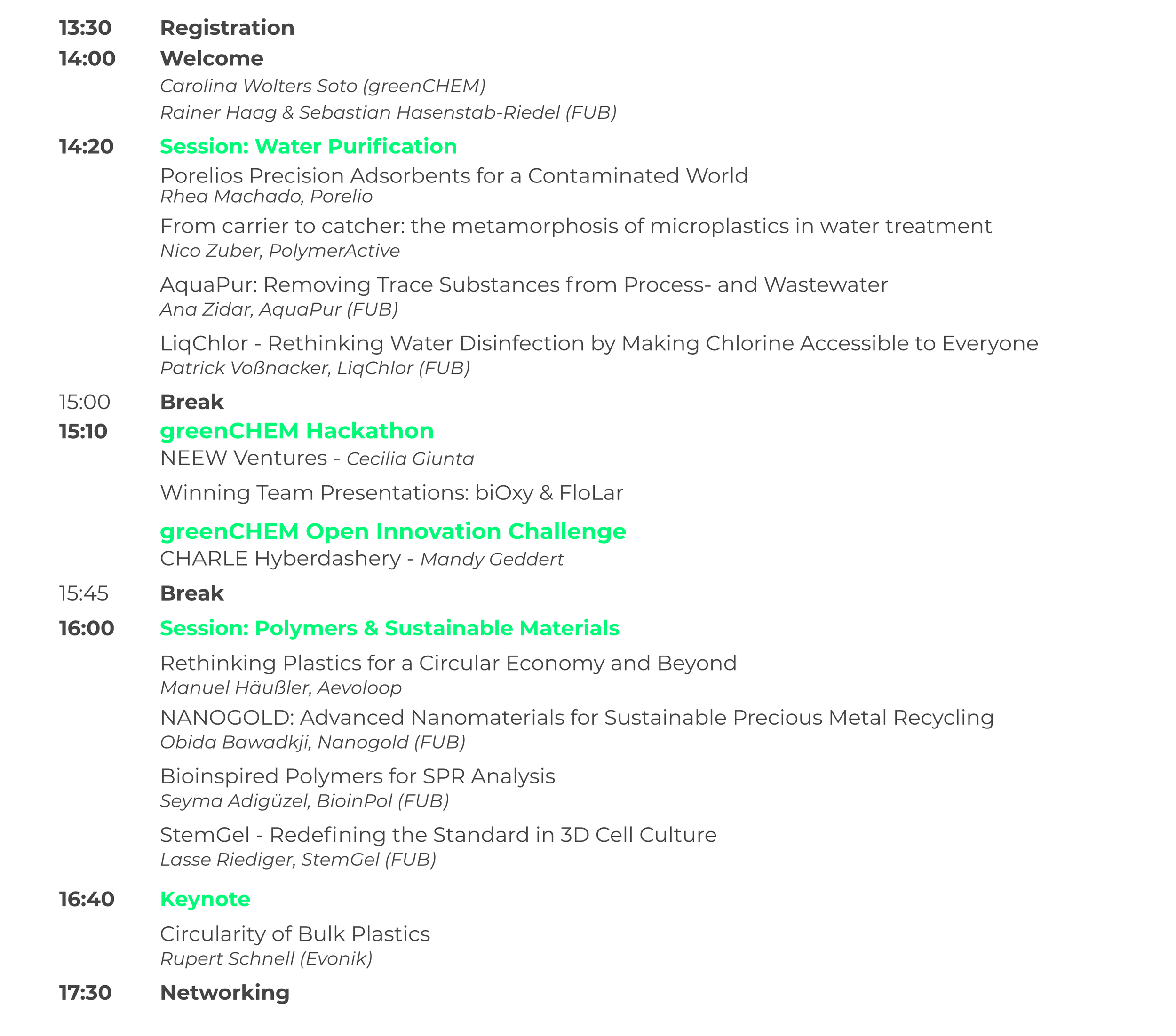
In the morning we offer a further education course for SME’s about the topic Scale-Up in Chemistry - From Flask to Factory at the same location. Industry representives are invited to register for this opportunity aswell.
Who should register?
Industry on campus focusses on bringing Phds and Post-docs in contact with the industry. We especially invite SMEs and Startups to join.

Impressions from previous years:

greenCHEM x CHARLE Open Innovation Challenge

Open Innovation Challenge
Industry meets green chemistry innovations
Applications to this challenge are now closed. Stay tuned for upcoming challenges in the next weeks!
Tackle a real challenge from industry
In our Open Innovation Challenge, greenCHEM invites researchers and startups to submit novel, green chemistry solutions to a real-world industry problem. Selected teams receive mentorship from the industry partner and specialists within our ecosystem, as well as access to laboratories and equipment to further develop their technologies for two to six months. After this elaboration phase, teams pitch their ideas to a jury. The winning team receives prize money and may enter a partnership with the industry partner to continue developing their solution.
Our Partner: CHARLE

The Open Innovation Challenge features CHARLE premium haberdashery, a Berlin-based company that has been developing high-quality, circular narrow fabrics for a wide range of applications. Specialized in elastic and non-elastic bands made from natural rubber, organic cotton, linen, and TencelTM, the company pursues environmentally friendly, resource-saving, and socially responsible production methods throughout the entire value chain. With a spirit of innovation and a clear focus on sustainability, the company works to create textile solutions that will also benefit future generations.
The Challenge
CHARLE is looking for a non-fossil-based, biodegradable elastomer that behaves like rubber with raw material sourced in Europe. In other words, they seek a sustainable, biogenic alternative to natural rubber to reduce its upstream CO₂ emissions caused by long-distance logistics and to prevent future supply chain disruptions by being source in the European continent.
-
1. What we are looking for at the end of the challenge
We want elastomers based on non-fossil raw materials, able to be sourced in Europe, with the following characteristics:
Potential for biodegradability
Potential for high elasticity
Potential for extrudability
Nice to have:
Very good resilience
High tear resistance
Excellent chemical resistance
High tensile strength
Durability
Thermal stability
2. Possible approaches
Use of food or natural textile waste (natural fibres) or a combination thereof
Plant-based alternatives with low carbon footprint
3. Approaches not of interest
Waste or materials of fossil origin
Alternatives based on Russian dandelion (due to high carbon footprint and land use)
Plant-based alternatives with high carbon footprint
Rewards
Prize: Compete to win a 2.000€ cash prize
Collaboration with Industry: Develop a solution with instant market fit, potentially leading to quicker implementation by CHARLE
Industry Insights: Visit CHARLE’s facilities and receive guidance from mentors with real world experience
Rapid Idea Validation: Use the Challenge to understand and validate the potential of your ideas in a short cycle
Infrastructure & Equipment: Develop, test, and prototype your ideas in laboratories and lab devices made available by greenCHEM
Community: Expand your network and increase the visibility for you and your idea
Timeline
26.11.2025 – Challenge presentation at Industry on Campus
23.01.2026 – Deadline for applications
30.01.2026 – Selection of teams
09.02.2026 – Challenge kick-off and datasheet handover
09.02-03.05.2026 – Elaboration phase*
May 2026 – Pitch Day & Award*
* Dates to be confirmed.
Q&A
-
You want to put your ideas to the test and contribute to making the industry more sustainable
You want to expand your network and meet people from industry
You want to do something that matters with your green chemistry skills
-
The Challenge is open to researchers and non-incorporated startups motivated to solve material challenges from the industry and able to come to Berlin for certain checkpoints, particularly the Kick-off and the Finale.
-
You can find the Terms and Conditions here.
-
All information about the IP conditions, you can find here.
-
greenCHEM will provide access to lab space and cover the costs associated with that for teams that require it. However, if your team doesn’t need a dedicated lab from greenCHEM, you may work in your current lab. In that case, we can cover some of the costs associated with participating in the challenge, even if we’re not the ones providing the lab.
-
No, at the moment of application your solution doesn’t need to have reached any of the established criteria. You only have to explain why is it that your team is confident that your idea could potentially reach the stated material characteristics. Should your team be selected to the second phase of the challenge (the Elaboration Phase), you will have the opportunity to work in the lab and further develop your solution.
The criteria play a bigger role at the end of the challenge. Then they are going to be used to evaluate the solutions presented and help the jury pick a winner. However, even at this point, there will not be hard targets that need to be reached.
And wildcard solutions are always welcome.
More Questions?
Arni, our Open Innovation Manager, is happy to answer your questions.
“Green rubber band ball” by Whoisjohngalt is licensed under CC BY-SA 4.0
Scale-Up in Chemistry - From Flask to Factory

Scale-Up in Chemistry
From Flask to Factory: an executve education course
Learn about scale-up for growth, market success, and risk reduction
Scaling up a chemical process can make or break innovation. This compact executive course will talk about actionable strategies for scaling up chemical processes in an industrial context, showcasing how green chemistry can help businesses to stay ahead: reducing costs, minimising risks, and accelerating time-to-market.
Hear directly from a successful startup and leading experts how integrating scaling up with green chemistry concepts can support SMEs with sustainable competitive advantages and stronger business performance. Throughout the morning, several rounds of moderated discussions will invite all participants to share their perspectives, address challenges, and ask questions freely in an open and collaborative atmosphere. This interactive format takes into account your key pain points and real-world experiences so that they are heard and incorporated into the rounds — hopefully leveraging the knowledge and connections needed to accelerate sustainable business growth.
Key Industry Benefits
Boost business performance: process innovation drives sustainable competitive advantage, securing your market position.
De-risk and accelerate scale-up: strategies to lower risks throughout the development pipeline.
Access cutting-edge facilities: see how modern scale-up labs support rapid, flexible, and resource-efficient commercialisation.
Network for growth: exchange with peers, service providers, and technology partners in moderated and open discussion sessions.
Program
10:00 – 10:10 | Welcome & Introduction
10:10 – 10:45 | State-of-the-Art Scale-Up Technologies
Professor Rainer Haag
Best practices, pitfalls, and innovations for green scale-up.
10:45 – 11:25 | Mastering the Scale-Up Process
Professor Kai Licha
Planning campaigns, optimising infrastructure, and balancing sustainability with market needs.
11:25 – 12:00 | From Idea to Reality
Dr. Rhea Machado
Porelio’s Journey: Turning Proof of Concept into Pilot Production.
12:00 – 12:20 | Lab Tour: See the Tools in Action Experience the equipment and pilot systems driving modern, sustainable chemical innovation.
12:20 – 12:30 | Closing Remarks
12:30 – 13:30 | Business Lunch Connect with all participants and presenters to discuss collaboration and strategies for implementing industry-leading green chemistry!
In the evening Industry on Campus will take place at the same location. Don’t miss the chance to register for that aswell!
Who should register?
Chemists, R&D Managers, and Technical Directors from SMEs in the chemical sector - all who are interested in scaling-up your production.