
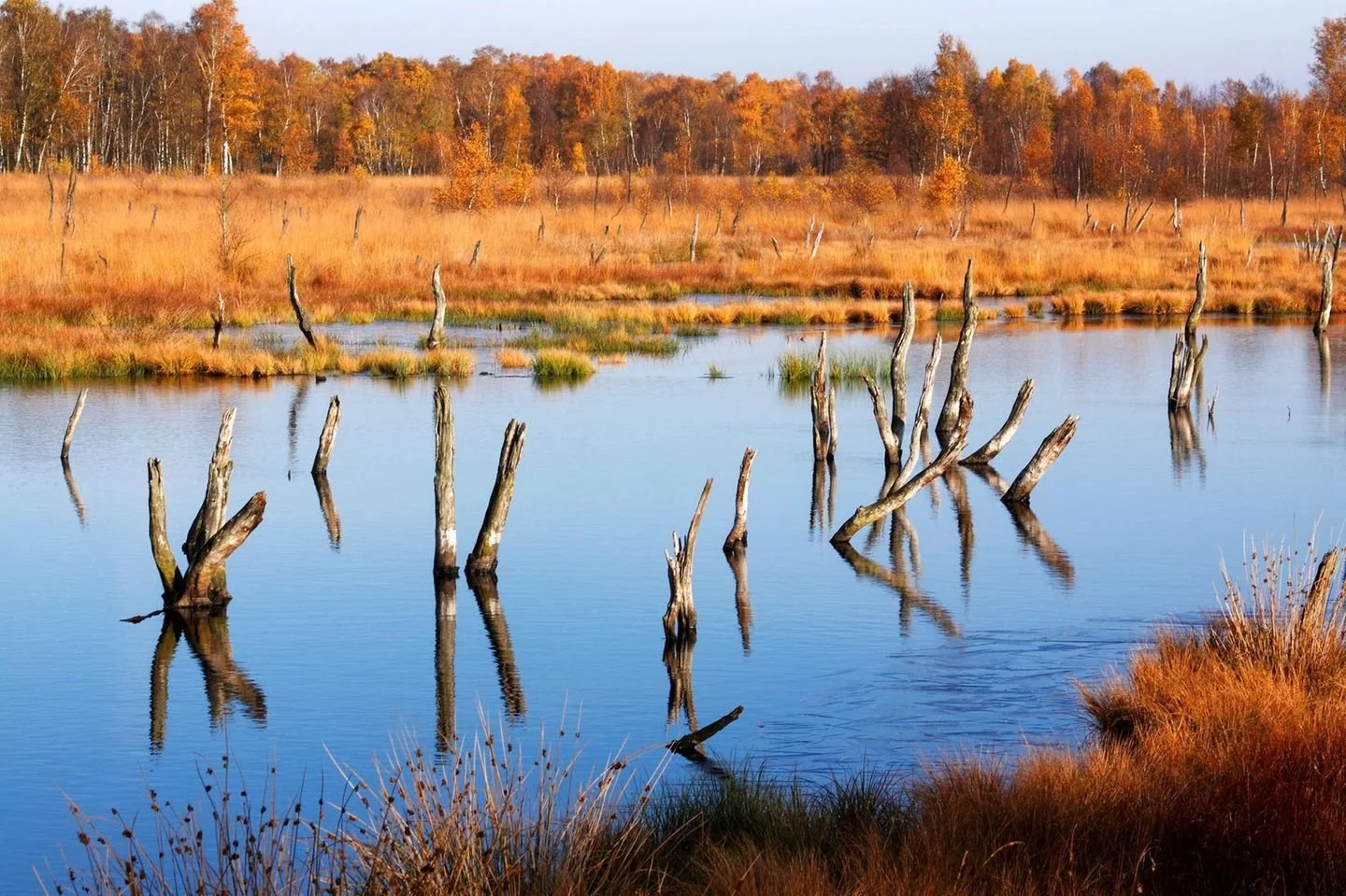
Paludi Challenge
Unlocking the Potential of Paludiculture Biomass
© Justus de Cuveland / imageBROKER / mauritius images
Turn underutilized biomass into real-world applications.
Are you ready to turn sustainability challenges into real-world impact?
Join our Innovation Challenge to develop solutions that unlock the value of paludiculture feedstocks.
We are looking for innovative, application-oriented solutions. Your mission is to develop and validate pathways to convert paludiculture biomass and side streams into market-ready materials, chemicals, or processes. We invite researchers, students, and early-stage teams to participate. We aim to bring creative minds together to address a critical sustainability challenge.
Our Partners
The Greifswald Mire Centre (GMC) is an interdisciplinary hub connecting science, policy, and practice in peatland research. It promotes paludiculture as an innovative solution to reduce CO₂ emissions while enabling sustainable land use. The University of Greifswald is one of the leading research institutions in peatland science, including paludiculture. It develops science-based approaches for restoration and sustainable use of rewetted peatlands, integrating ecological insights with economic and policy-oriented solutions.
The Startup Labor Schwedt is an innovation hub connecting startups, industry, and research to scale sustainable industrial solutions. It supports the development and real-world application of climate-friendly technologies, driving the transition to a circular and climate-neutral industry.
This is where you come in.
-
But what exactly is paludiculture—and why does it matter?
Paludiculture means using wet or rewetted peatlands for farming or forestry. This way, the peatland stays healthy and can continue to store CO₂, which is good for the climate.
It also creates new opportunities to make climate-friendly land use economically viable.
What is the problem right now?
Biomass from paludiculture currently has difficulty competing with other raw materials.
The main challenges are:
• There are only a few ways to process it on a large scale
• There is strong competition from existing materials
• The quality of the biomass is not always consistent
• There is low market demand and uncertain investmentWhat is the Paludi Challenge?
The Paludi Challenge is an initiative that looks for new ideas and solutions.
The goal is to make paludiculture biomass economically useful.
A key focus is to develop processes that turn biomass and/or its byproducts into sellable products, such as chemicals, materials, or industrial processes.
What kind of ideas are we looking for?
The challenge is open and flexible – there is no single fixed solution.
Possible ideas include:
• Development of materials, additives, or packaging
• Use of byproducts (e.g. lignin or hemicellulose)
• New processes or pre-treatment methods to improve usage
• Solutions for technical problems in processing
Wildcards are welcome. You do not need to have a solution already. An idea is enough to apply. You will receive guidance on how to tranform your idea further during the program.
What we offer
Training: Receive hands-on training in key areas such as Life Cycle Assessment, business modelling, and pitching.
Industry Collaboration: Join us on a tour of a real chemical facility, go behind the scenes, and connect with industry experts. Gain practical insights and develop solutions with real-world impact.
Rapid Idea Validation: Use the Challenge to understand and validate the potential of your ideas in a short cycle.
Infrastructure & Equipment: Develop, test, and prototype your ideas in laboratories and lab devices made available by greenCHEM.
Community: Expand your network and get in contact with a diverse ecosystem.
Further Support: Receive potential access to funding opportunities or validation/pilot projects.
Timeline
iStock by Getty Images
Phase 0 – Qualification
April 30— Challenge launch & start of the application phase
• May 30 — Application deadline
• First week of June — Selection and announcement of finalists
Phase 1 – Elaboration
• June 8 — Kick-off event, introduction to the challenge & matchmaking session
• June 18 — Workshop: Life Cycle Assessment (LCA)
• June 23 — Workshop: Business Model Canvas (BMC)
• July 6 — Industry excursion*
• July 13 — Mentoring Session I
• July 20 — Pitching workshop
• July 30, 2026 — Phase 1 Pitch Day & selection of the two winning teams
Phase 2 – Lab Phase
• Beginning of August — Start of the lab phase*
• End of August — Mentoring Session II*
• End of September — End of the lab phase & Final Pitch Day*
* Dates to be confirmed.
Application Deadline: 30th of May, 2026
〰️
Application Deadline: 30th of May, 2026 〰️
Our Workshop Trainers
We are excited to collaborate with an interdisciplinary group of workshop trainers supporting participants throughout the challenge.
Janna Kuhlmann
Workshop Lead in Life Cycle Analysis
Janna is enabling start-ups since over five years to develop and improve their ideas early in the process, based on life cycle assessment (LCA) data.
She has worked for consultancies in the field of cradle to cradle certification and regulatory chemistry. Since recently, she is assisting greenchem start-ups with their first steps in the EU chemicals regulation REACH.
Her background is in environmental chemistry and ecotoxicology, eager to work towards a non-toxic circular economy.
Elif Nisa Ersoy
Workshop Lead in Business Model Canvas
Nisa is a manufacturing and scale-up engineer with experience in bringing technologies from pilot to production.
She has worked in industrial environments including Tesla and global manufacturing companies, focusing on process development, production ramp-up, and operational scaling.
Today, she supports early-stage and research-based teams in translating technical ideas into realistic, scalable business models with a focus on feasibility, execution, and real-world constraints.
Jelle De Wit
Workshop Lead in Pitching & Communication
Jelle is a Berlin-based pitch and public speaking coach from Belgium.
He supports researchers in communicating their ideas with clarity, confidence, and impact—whether in presentations, pitches, or interdisciplinary settings.
His approach combines strong content with storytelling, body awareness, voice, and presence, drawing on his background in devised theatre and performance.
Q&A
-
You want to put your ideas to the test and contribute to making the industry more sustainable
You want to expand your network and meet people from industry
You want to do something that matters with your green chemistry skills
-
This challenge is designed for:
PhD students & postdocs
Master students
Early-stage teams (not incorporated)
Individuals or interdisciplinary teams
We aim to include people from all backgrounds to ensure an interdisciplinary challenge. You do not need any specific qualifications to participate.
Eligibility: Applicants must be based in or near Berlin and able to attend the program in person on the scheduled dates. Additionally, applicants must be affiliated with one of the partner universities within the BUA.
We can only provide lab access to individuals with prior laboratory experience. If you or your team do not meet this requirement, we will support you from the beginning by connecting you with interdisciplinary team members who have the necessary experience to enable lab work.
If you are alone and you do not have a team yet, do not worry! You can still aplly and we will match you with participants from interdisciplinary backgrounds on the first day of the challenge. -
To be considered, applicants must complete and submit the application form, including information about their background and a clear description of their idea, solution, or insights. Participants are also encouraged to support their submission with additional materials such as detailed concepts, videos, explanations, or references to relevant resources like peer-reviewed articles or patents. Submissions will be evaluated based on five key dimensions: market potential, technical feasibility, sustainability, innovation, and industrial relevance.
The program unfolds in two interconnected phases that guide teams from idea development to hands-on validation.In Phase 1 — Elaboration, an open call leads to the selection of 5–7 teams, who then focus on developing and refining their ideas. Throughout this phase, participants receive mentoring, take part in workshops, and gain support in validating their concepts. The phase culminates in a pitch to a jury, where the top two teams are selected to move forward into Phase 2.
Building on the outcomes of Phase 1, Phase 2 — Lab Work offers a more practical, experimentation-driven environment. The selected teams enter the lab to test and technically validate their approaches, continuously iterating with support from experts. The program concludes with a final pitch and award, showcasing the most promising solutions.
Please note: We typically recommend to form teams with not more than four team members in the beginning. In addition, we strongly advise including a scientific supervisor or professor who can provide guidance throughout the entire challenge.
All sessions in the first phase of the program will take place in person; online participation will not be available. -
You can find the Terms and Conditions here.
-
All information about the IP conditions, you can find here.
-
greenCHEM will provide access to lab space and cover the costs associated with that for teams that require it. However, if your team doesn’t need a dedicated lab from greenCHEM, you may work in your current lab. In that case, we can cover some of the costs associated with participating in the challenge, even if we’re not the ones providing the lab.
-
At the application stage, you do not need a fully developed solution.
We are looking for:
A clear idea or concept
A strong hypothesis or approach
A convincing explanation of its potential
Selected teams will further develop their solution during the program. Should your team be selected for the second phase of the challenge, you will have the opportunity to work in the lab and further develop your solution.
And wildcard solutions are always welcome.
-
Teams may focus on one (or combine) the following paths:
Path A — Product-first / Market pull
Investigate materials, additives, binders, coatings, composites, and packaging-related solutions based on paludi inputs that could enable future market applications.
Path B — Side-stream conversion ( “leftover streams” )
Secondary material streams can be repurposed for other products or processes. Develop approaches to upgrade side streams (e.g., hemicellulose- and lignin) into valuable chemical intermediates, materials, or precursors.Path C — Solve a bottleneck ( Fixing a technical process limitation)
Develop a concept for pre-treatment/ fractionation/ separation steps that enable better yields, purity or robustness for paludi utilization.
More Questions?
Join our Info Session on 19.05.26 at 2 PM. Ask your questions, gain deeper insights into the challenge, and get to know the team behind it.

If you can not make it to the Info session, Arni, our Open Innovation Manager, is happy to answer your questions.